
Find AI‑written text on your own computer.
Linda tells you whether a text looks AI-generated and highlights the suspicious passages.
12 attempts · up to 6,000 characters · at least 20 words (300+ recommended). TXT, MD and DOCX. The online demo sends text to a server; the desktop app runs locally.
Texts and models stay on your PC
Detection runs locally. Model downloads are about 0.3 GB for Loupe or 2.9 GB for Assay; inference can work offline. Updates and licence activation/periodic checks use internet connections without uploading checked texts.
Free for personal non-commercial use. No key needed — download and check.
Microsoft Store updates usually arrive about a week later than GitHub. Need the newest version right away? Use the GitHub installer.
on CPU
81% of 1,675 AI texts rewritten by 16 “humanizer” tools are still recognised as AI (public HumanizerBench set, not used for training). Details in Results
Linda Assay and Linda Loupe
Choose what suits your computer. You can install either one or both, and change it later in Settings.
Current versions: app 2.0.7.0 · model package 1.3.4.1. Assay FP32 stable / Loupe CPU; short AI inserts may be missed.
Linda Loupe
Light and fast. Works on any computer, even an old laptop without a gaming graphics card.
- A check takes seconds
- Small download (about 0.3 GB)
- Slightly less accurate
Linda Assay
The most accurate version. Best with a modern graphics card.
- Highest accuracy
- Download about 3 GB
- On a weak computer a long text can take minutes
Not sure?
Start with Linda Loupe. It runs everywhere. If you later want maximum accuracy, add Linda Assay in Settings with one click.
what Linda Assay finds, and how often it is wrong
plain AI text caught
on the public Chicago Booth benchmark (texts from GPT, Claude, Gemini), with 1% false alarms on its human texts.
caught after a humanizer
the same texts after the StealthGPT rewriting tool. Pangram reaches 98%: on humanized text we are behind it.
Russian and Polish AI texts
caught on our own test sets, at 0.6% (Russian) and 1.4% (Polish) false alarms. The sets are small: expect ±5 points.
false alarms on non-native essays
TOEFL exam essays by non-native writers are the weak spot (about 0.2–0.4% on ordinary and school texts). Use Precise mode for such work.
Our own evaluation, not an independent audit. Details and limits: Results and the technical report. Details in Results
three detectors, one verdict
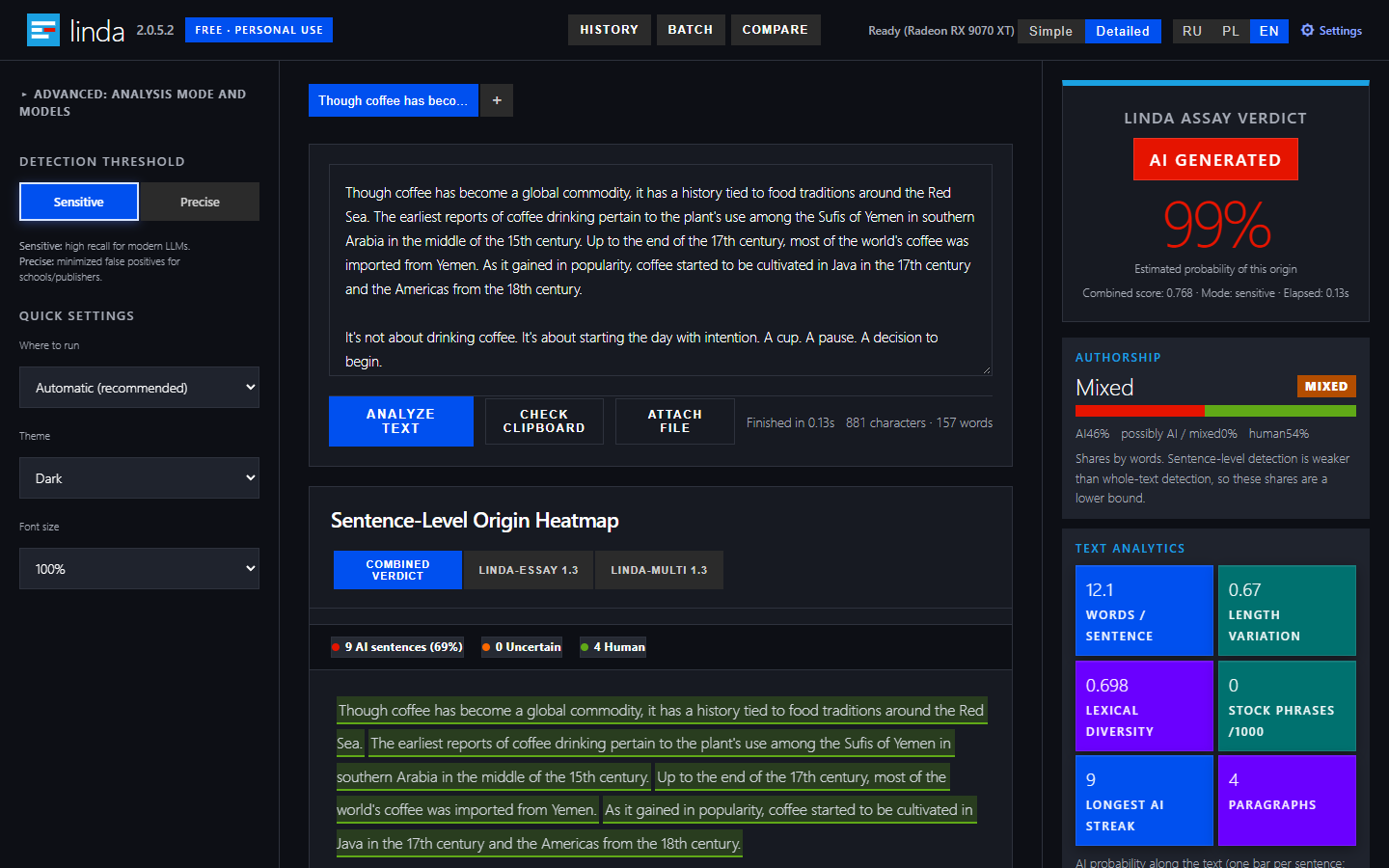
Three independent checks vote, and your text is reviewed part by part. You get one clear verdict, with the suspicious passages highlighted.
Paste or drop a file
Paste text or upload TXT, MD, DOCX or PDF. Files: up to 20 MB; PDFs: up to 500 pages. Longer texts take more time to analyse.
Get a verdict
AI, uncertain or human; the share of AI-looking text for mixed authorship; a colour map of the passages.
Choose: catch more, or accuse less
Sensitive finds more AI writing, but may wrongly flag a human text more often. Precise says “AI” only when two independent checks agree — fewer false alarms, but some AI writing slips through. For schools and publishers, where a false accusation hurts most, use Precise.
progress: 1.1 → 1.3.1
HumanizerBench gave every detector the same rewritten texts. Share flagged as AI — higher is better.
Competitor verdicts as published by the benchmark operators; their thresholds are unknown, so false-positive rates are not comparable.
start free, pay only for commercial use
For personal tasks, study and hobbies the program is free forever — no cut-down features, no time limits. Paid options are for commercial activity (freelance, editing, checking others’ work to order, companies). Buying a key gives the official right to commercial use and removes the licence reminder in the interface.
Free
- Personal, non-commercial use: your own texts, study, hobby, non-commercial research
- The same app and models, no key, no limits
- Works offline, nothing is uploaded
Personal
- 1 person, up to 3 devices
- Freelance and small business
- Works offline after a one-time activation
Team
- Up to 10 people, 20 devices
- Commercial use
- Works offline after a one-time activation
Organization
- Company, school or university, one site, 200 devices
- Updates for the whole year, new models included
- Invoice with VAT details
Not sure what counts as non-commercial? Read the rules.
Choose Team on the checkout page.
OEM, white-label, exclusive rights, custom calibration
Integrating Linda into your platform (LMS, plagiarism checker, publishing or HR tool), calibrating on your own texts, or buying exclusive rights: write to lindapro.support@proton.me with your use case, volume and deployment.
faq
What does the percentage in the result mean?
It is the confidence in the verdict shown next to it (“AI”, “human” or “uncertain”), not the share of the text written by AI: 88% next to “AI” means the models are fairly sure the text is machine-written. The share of the text that looks AI-written is shown separately (the colour map, “AI share” and the authorship bar). A high percentage is a reason to look closer, not proof; see “If the score is high”. Very short texts (under about 150 words) give less reliable results, and the app warns about it.
Are my texts uploaded anywhere?
No. Texts are analysed on your computer. The app connects to the internet only to download model files, to check for updates and, if you enter a key, to check that key (the key and a random device label are sent, nothing else).
Is it accurate? Can it accuse a human by mistake?
No detector is perfect. On held-out human texts the false-flag rate is about 0–2% for general writing, and 5.5% for TOEFL exam essays in sensitive mode (about 1% in precise mode, measured on version 1.3). Writers who are not native English speakers are affected more. Never use a result as the sole basis for decisions about people.
What about AI “humanizer” tools?
Version 1.3.1 uses new models merged from three trained variants. On a public humanizer test it flags 81% of rewritten texts (version 1.1: 70%, version 1.0: 31%). Humanizers change every month, so the models are updated regularly and the app downloads the updates.
Which languages?
English is the main language, but Russian and Polish now run on the same models. On our held-out test sets (350 AI and 350 human texts per language) the verdict “AI” catches about 80% (Polish) and 78% (Russian) of AI texts at 0.9% and 0.6% false alarms (version 1.1: 39% and 57%). Texts from newer models and rewritten texts are caught less often (Gemini-rewritten Polish: 48%, Russian: 50%). The sets are small, expect ±5 points. We have not measured Russian or Polish against other detectors, so we make no comparison claim. Other languages are not supported. Exact figures are in the results section.
Is it free?
Yes — for personal non-commercial use: your own texts, study, hobby, non-commercial research. No registration, no key, no limits. A paid key is only the permission for commercial use (paid work, clients, companies, schools and universities, products): it hides the licence reminder; the app itself works the same without it. See pricing.